
These bins are kinda sus… tainable
Let’s learn about our town’s temporary textile bins, and how they’re making our festive celebrations greener.
Green Town -
20/03/2026
Share to:


https://enewsletter.tptc.org.sg/these-bins-are-kinda-sus-tainable/
A foreigner once described the climate in Singapore with brutal accuracy and elegant succinctness: “It’s either hot, or hot… and wet.”
We don’t have four seasons in our tropical island home. Yet ‘spring’ cleaning occurs multiple times a year as our various communities gear up to celebrate their major festivities.
Out with the old, in with the new
We get it. As we welcome a major celebration – frequently marking the start of a new year – we all want our homes, wardrobes, and other belongings to be either sparkling clean or brand-new – radiating the freshness of spring. Some of us believe it’s auspicious. All of us know it just feels… good.
More crucially, science has proven that – contrary to its association with spring – this practice is one of the reasons why festive seasons are some of the least ‘green’ times of the year.
The most damaging period of all
We throw out lots of items during spring cleaning. And given Singapore’s ethnic make-up, it’s no surprise that the weeks leading up to Chinese New Year are when we spring-clean most intensely.
Among the most common materials discarded during this time are textiles. From clothing to curtains and upholstery, we chuck out tonnes of textiles to make room for what’s new and in-trend.
The best way to minimise the damage
Specialised collection points for recyclables are among the most effective ways to mitigate their negative ecological impact.
This is why Tanjong Pagar Town Council has worked closely with various partners for years to provide residents with dedicated recycling collection points for materials such as electronics, paper, used cooking oil, food waste and yes, textiles.
However, we also recognise that the holiday season is when you’re specially busy: spring-cleaning, shopping, finishing up work and juggling a million other tasks. Instead of discarding items at specialised collection points, it may just be easier to chuck it all into a nearby Bloobin or general-purpose green bin.
It’s inconvenient to be eco-friendly when you’re this busy. But don’t worry, your Town Council has an answer for that, too.
Convenience against climate change
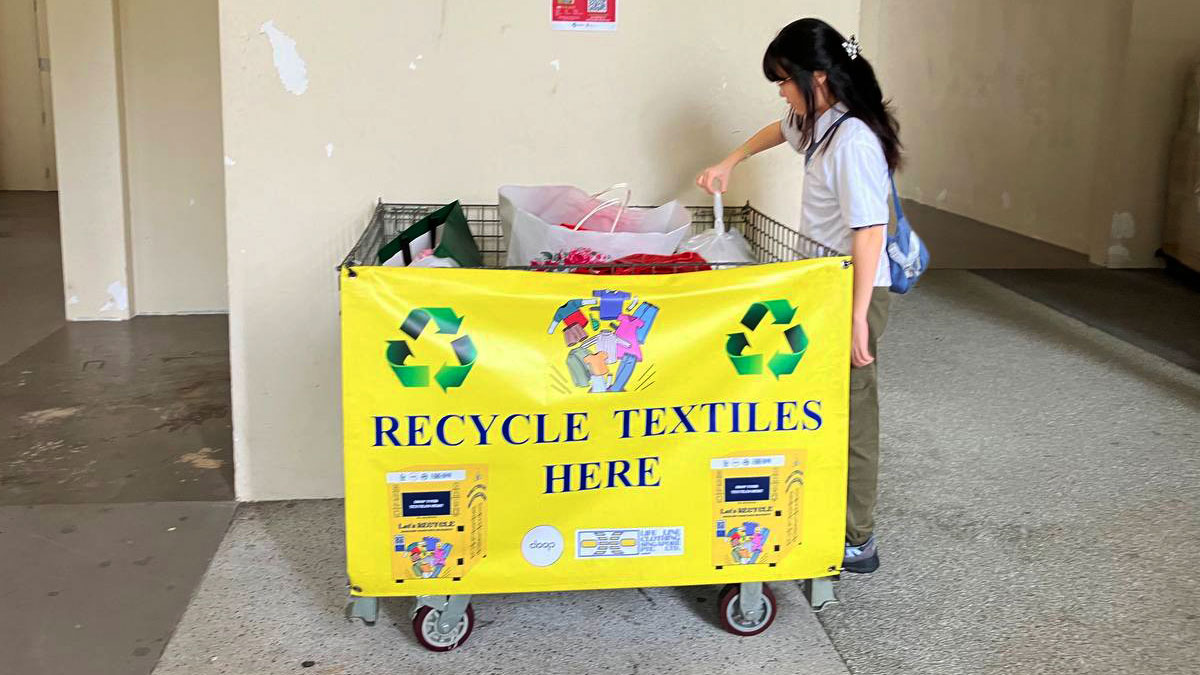
Since early 2024, it’s become our annual practice to set up temporary textile bins across our town in the weeks leading up to Chinese New Year.
These complement our permanent textile bins (which are available all year) by serving two key functions:
1. Helping to reduce the travel distance to a textile collection point, making it easier for residents to dispose of old textiles in an environmentally responsible manner.
2. Taking on some of the load during this period when an especially high volume of textiles are discarded.
We have at least one temporary textile bin in each of our Divisions, and review their locations every year to ensure they serve the maximum number of residents.
Our report card for 2026
This year, we set up 10 temporary textile bins across our seven Divisions between 24 Jan and 13 Feb 2026. During this period, we’re happy to report that we collected 1,218kg of textile waste just from the temporary textile bins alone.
There’s even better news: we also added 3 permanent textile bins around our town last year, bringing their total number up to 24. Throughout 2025, these permanent bins received over 200 tonnes of textile waste – 203,883.51kg to be exact.
What happens to the textiles?
We work in partnership with Cloop, a Singapore-based social enterprise to set up the textile bins and give the collected textiles a new life.
Cloop will distribute items which are in good condition for reuse via thrift shops or donations to communities in need worldwide. Items which are not in useable condition may be upcycled into new products or, as a last resort, downcycled into items like cleaning rags to keep them out of landfills.
As much as possible, Cloop will endeavour to keep the reuse/recycling of the textile waste within Singapore to minimise their carbon footprint.
How you can get involved
You can recycle more effectively by leaving your unwanted items at our specialised recycling collection points for textiles, electronics and more – all of which are available year-round. Just visit our website to
see the full list
of these collection points.
In the weeks before Chinese New Year, do check our Facebook or Instagram pages to see the locations of our temporary textile bins.
Together, let’s continue to make Our Tanjong Pagar an eco-friendly community!